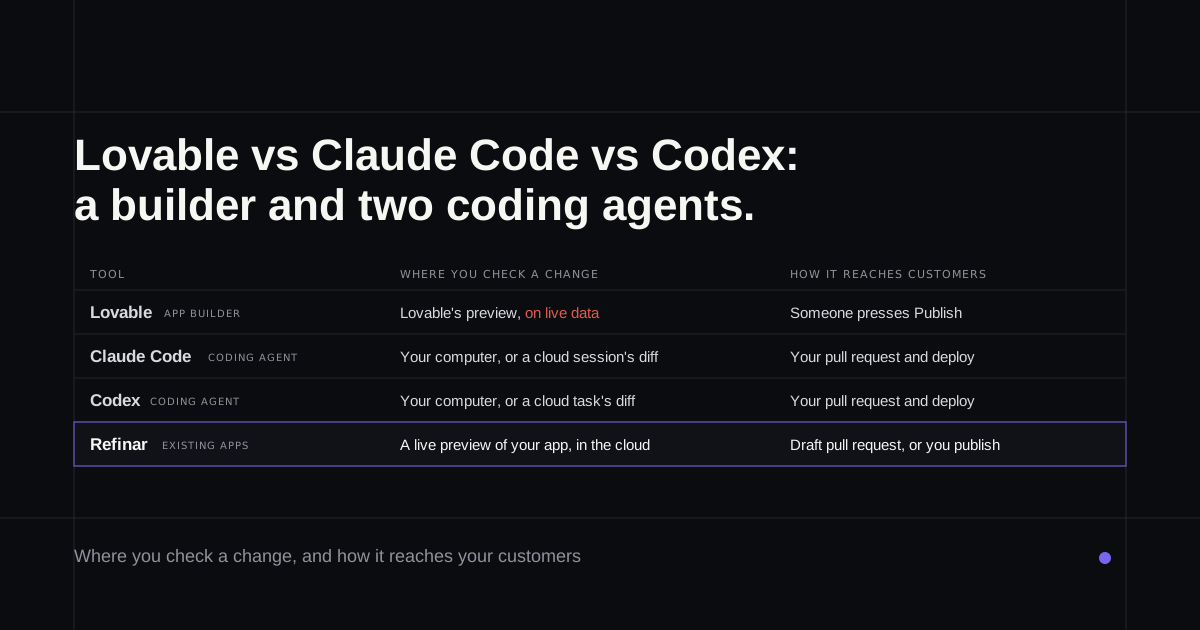
You've got an app, or the idea for one, and two kinds of advice. One friend says Lovable will have it live by tonight. Another says anyone serious uses Claude Code, and lately someone in the group chat says Codex. So it becomes Lovable vs Claude Code, as if they were rivals, but they're different kinds of tool. Lovable is an app builder that hosts what it builds. Claude Code and Codex are coding agents, from Anthropic and OpenAI, that work inside code you already have. The useful questions are whether your app exists yet, and who checks a change before customers see it.
If your app is already live on GitHub and nobody on your side writes code, none of the three is a clean fit, and the last section covers a tool made for that case.
Lovable vs Claude Code vs Codex at a glance
| Lovable | Claude Code | Codex | |
|---|---|---|---|
| What you need to know | How to describe what you want | How to run the app and read a diff | How to run the app and read a diff |
| Where the code lives | Lovable, synced to a new GitHub repo | Your repository | Your repository |
| Opens a repo you already have | No | Yes | Yes |
| Where you check a change | Lovable's preview, on live data | Your computer, or a cloud session's diff | Your computer, or a cloud task's diff |
| How it reaches customers | Someone presses Publish | Your pull request and deploy | Your pull request and deploy |
| Entry price (monthly) | Free plan; Pro $25 for 100 credits | Claude Pro, $20 | Free in the desktop app (rolling out), Plus $20 |
Prices from each vendor's own docs and pricing pages on 4 October 2026.
Lovable
Best for: getting the first version of a web app live without touching code.
Lovable is the only one of the three that hosts your app. You describe it, Lovable writes the code and runs it on Lovable Cloud, a built-in backend on Supabase with a database, sign-in, file storage and server functions. Nothing to install, no terminal.
Git sync works on every plan, Free included, and edits then flow both ways between Lovable and GitHub (how the sync works). Linking always creates a new repository, though, so Lovable can't pick up an app that already lives somewhere else (the details).
One thing matters more once people use the app. Lovable calls its preview your staging environment, but its preview docs also say the preview and the published app share the same backend and data. Drafts, its way of trying a change on a copy of the project, use the real data too. Test a "delete my account" button in the preview and a real account disappears. Comparing builders instead? See Emergent vs Lovable.
Claude Code
Best for: a developer, or someone happy to work like one, changing code that already exists.
Claude Code reads your codebase, edits files and runs commands, and it doesn't mind whether the code began as a Lovable export or a contractor's monorepo from 2019. You can run it in a terminal, your code editor, the Claude desktop app or a browser. Its office-work sibling is a separate product, compared in Claude Cowork vs Claude Code. The browser version, generally available since 23 September 2026, clones your GitHub repository onto a machine Anthropic manages and leaves a diff you can turn into a pull request (how that loop works).
Checking the result asks more of you. In the desktop app, Claude can start your app in a built-in browser pane to try its own work, which usually means the project runs on your computer, keys and all. A cloud session mostly gives you a diff, which an engineer reads in a minute and most founders can't.
Codex
Best for: teams that already work in ChatGPT, and designers who'd rather point at a page than describe it.
Codex has a CLI for the repository on your machine, an extension for your code editor, and Codex Cloud, where each task gets its own workspace and ends in changed files you review before committing or opening a pull request.
The desktop app is the part for non-developers. It began as the Codex app for Mac in February 2026 and now lives in the ChatGPT desktop app as a Codex mode. Since April it has had a built-in browser: open your app there, select Annotate, click the button that looks wrong, type a comment and ask Codex to deal with it (OpenAI's browser docs). For a designer, that beats describing a misaligned button in a paragraph.
The catch is that the page you annotate is normally the app running on your own computer, so the repository and everything it needs must be there first. And like Claude Code, Codex never publishes.
How a change reaches your customers
In Lovable, the person prompting can also be the person publishing. By default anyone with editor access can press Publish, restricting that is an Enterprise setting, and apart from a quick security scan nothing else sits between a prompt and the live site.
With Claude Code and Codex, the gate is GitHub. Both hand back a branch or a pull request, and nothing ships until someone merges it and your deploy runs. With paying customers that's usually the review you want, and it's why both tools assume a developer is around.
What each costs
On Lovable, the Free plan hands out build credits at 5 a day and stops at 30 for the month. Pro costs $25 a month for 100 credits, and the same credits pay for hosting once the monthly 20-credit Cloud grant runs out (Lovable pricing has the detail).
Claude Code isn't on Claude's Free plan. Pro is $20 a month ($17 paid yearly), Max starts at $100, and Claude Code shares one usage allowance with your chats (Claude pricing).
Codex is bundled into ChatGPT plans. Plus ($20 a month) gets it on the web, in the CLI and in your editor, and Pro starts at $100. Free and the $8 Go plan get it in the desktop app as it rolls out (Codex pricing). Neither agent's price includes anywhere to run the app, so hosting is a separate bill.
A new app, or one with customers?
- Nothing built yet, and nobody codes: Lovable.
- Built in Lovable, and a developer is joining: use both. Lovable accepts commits from any Git tool, so the developer can work in Claude Code or Codex on a feature branch and merge after review.
- A developer owns the code and you pay for Claude: Claude Code.
- A developer owns the code and the team lives in ChatGPT: Codex.
- The app has customers and a GitHub repo, and whoever asks for changes doesn't code: read on.
If your app exists and nobody codes
Lovable won't open the repository you have. The two agents will, but they expect someone to run the app and judge a diff.
Refinar is made for that gap. It opens your app from GitHub and runs it in the cloud, so your laptop stays out of it and the preview is your actual product. Type what you want changed, or point at the spot in the preview, and an AI agent does the work in front of you. Until you publish, any single change can be taken back on its own. Work that reaches into logins, payments or customer records never goes live by itself: your developer gets it with a written brief, or one of Refinar's developers reviews it within four hours on business days if there's nobody to send it to (how it works). It's $50 a month to start, with 20 teammates on every plan (pricing), and starting from nothing is Lovable's job or Refinar's Foundation build.
If your app lives on GitHub and the terminal is what's stopping you, try Refinar on it.