platform transition · 6 min read
JetBrains Matter Alternatives for Product Teams (2026)
Matter lets PMs and designers change a real codebase, but it's still early access. Five alternatives that work on the repo you have, and what each asks of it.
Updated 2026-09-22
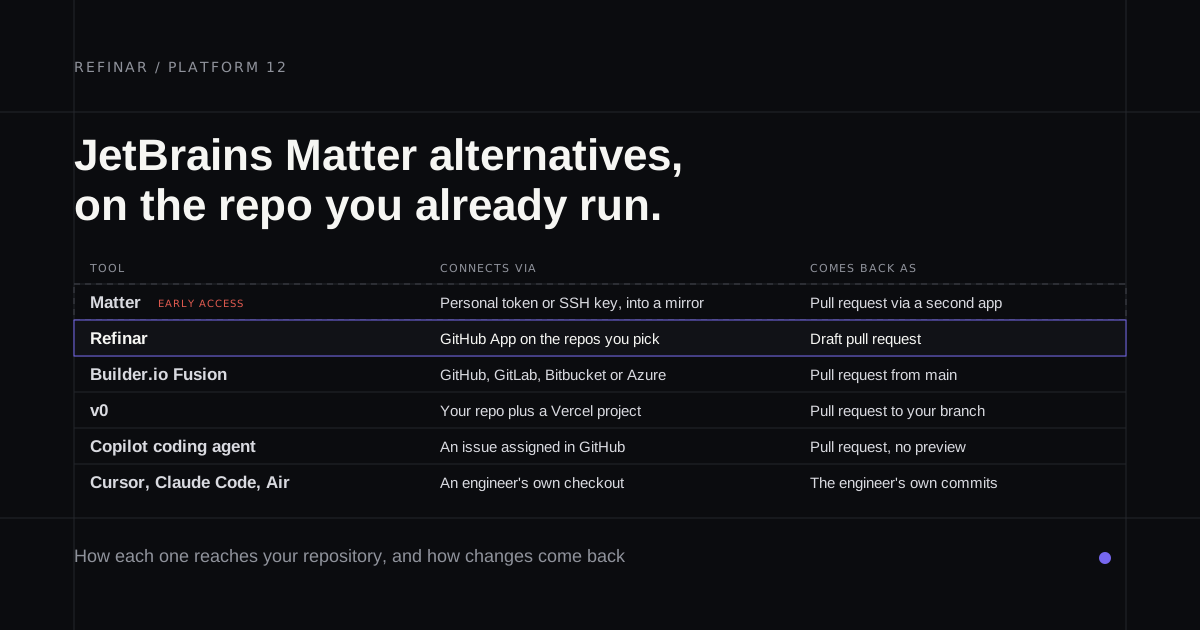
If you've been on the JetBrains Matter waiting list, or you got in and hit a wall with your own repo, you're probably here for the reason we started building Refinar. You want the people who decide what the product looks like to change the real app, and you want engineers to receive those changes as a pull request they can review. Matter pitched exactly that when it launched in October 2025.
Eleven months later it's still early access, with no published price. So here's what else works on a repository you already have, with Matter described first so you can see where each option fits.
What Matter does
An administrator starts by pasting your repository URL. Matter's setup guide then asks for credentials to read it: a personal access token for most GitHub repositories, otherwise an SSH private key or a username and password. From there Matter works on its own copy, a Git mirror in its cloud, where each idea becomes a branch and each version a commit.
The preview needs a frontend dev server (Vite, Webpack and Create React App are the examples given), plus any secrets it detects and asks you to fill in. Teammates join a thread with @mentions, and Figma frames can be pasted in as a reference. When something's ready, a separate GitHub App opens the pull request, or Matter writes an issue draft instead.
It's a thoughtful product, and the JetBrains name will carry it a long way.
Why people look elsewhere
Early access has an off switch. The EAP terms make Matter free during the programme and let JetBrains limit access or end it whenever it likes. JetBrains also isn't obliged to keep your outputs. None of that is unusual for a preview. It's a shaky base for a team's weekly routine.
Backends are a question mark. Every project needs at least one frontend service. A React app with an API beside it is the happy case. A Rails or Django monolith, or a change that lives in a background job, is worth testing before you plan around it.
The keys belong to a person. A personal token or SSH key is tied to one account rather than to the repository. When that person leaves, somebody has to remember what it unlocked. Most security reviews prefer an app installed on named repositories that an org admin can revoke in one place. Matter does install one, but only for the pull request at the end.
One thing that isn't a reason to leave: Matter sends code to outside AI providers and says it won't train on it without consent. Every tool below sends code to a model provider too, so ask each of them the same question.
Refinar
Best for: a PM or designer changing the live app, backend and all, with a developer approving the risky parts.
Access works the way a security review wants it to. A team admin installs our GitHub App on the repositories Refinar should see, and uninstalling it cuts access off (connecting your app to GitHub). Nobody pastes a token.
We then boot the whole app in a sandbox, the frontend and the server behind it. That's why the preview behaves like production: it talks to the database and payment provider you already use, read-only until someone approves a write. Checkpoints undo any file change. Commands that can't be undone never run. Anything touching sign-in, payments or customer data is held until a developer approves it, one of yours or one of ours.
What comes back is a draft pull request on its own branch (publishing or sharing a change). It's GitHub only for now, and an app that opens a raw Postgres socket won't connect from a preview. Plans start at $50 a month with 20 teammates included. We make Refinar, so weigh this entry accordingly.
Builder.io Fusion
Best for: a design team that wants a visual canvas on a React, Vue, Svelte or Angular app.
If Matter's idea appeals but you'd rather drag things around than prompt, look at Fusion. It connects to GitHub, GitLab, Bitbucket or Azure DevOps, runs the app in Builder's cloud and sends changes back as a pull request cut from main. Know two things going in: only those four frameworks are supported for now, and it drops a .builderrules file into your repository. Pro is $24 per user a month and Team is $40, plus agent credits. We go further in Builder.io Fusion alternatives.
v0
Best for: a Next.js app that already ships on Vercel.
Vercel's builder has worked on imported repositories since January 2026, private ones and monorepos included, and its pull requests respect branch protection. The price of admission is a Vercel project attached to the repo, and a preview that only sees Development variables. If your app runs on Fly or your own servers, our v0 write-up explains the knock-on work.
GitHub Copilot coding agent
Best for: a GitHub team where developers review everything anyway.
A PM files an issue, assigns it to Copilot, and a pull request turns up from an Actions sandbox, from $10 a month per user. There's no running preview, so whoever judges the change is reading a diff. Plenty of teams are fine with that. It's also the exact handoff Matter was built to remove.
Cursor, Claude Code or JetBrains Air
Best for: an engineer who'd rather make the change directly.
When the person with the idea writes code, give them an agent in the repository and skip the platform. JetBrains' own Air fits here for teams already on its IDEs. None of these reach the PM who won't open a terminal.
Which one should you pick?
- The app has a backend, or security wants per-repository access: Refinar.
- Designers want a canvas and you're on one of the four frameworks: Builder.io Fusion.
- Next.js on Vercel: v0.
- A developer reviews every change regardless: Copilot coding agent.
- You're in the Matter EAP with a frontend-first app: stay, and open pull requests often so the work lives in GitHub.
Once non-developers are shipping, someone has to decide who approves what. How product managers can safely make changes to a production app is our take on that split, and if your designers live in Figma, see Figma Make alternatives.
If you've been waiting on Matter, you don't have to wait on us. Connect a repo and ask for one small change. I read the support requests that come in, so if it doesn't work for you, tell me why.