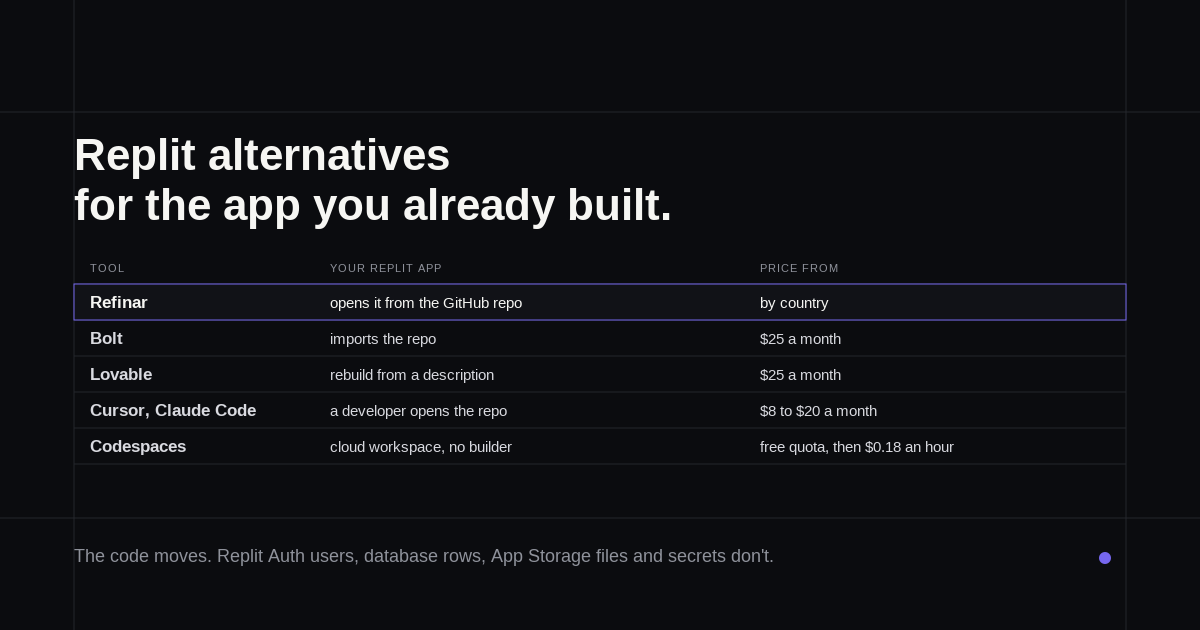
Most lists of Replit alternatives are written for someone choosing where to start. This one is for someone who already has an app on Replit, with users signing in and a database that keeps growing, and who is now outgrowing the platform or the monthly bill. For that reader, two things matter about each tool: what it costs, and what happens to the app you already have.
The list starts with Refinar, which works on an existing app from its GitHub repository. A short section near the end covers what actually leaves Replit with your code and what has to be rebuilt or moved by hand.
Why people look for a Replit alternative
The bill is the usual trigger. Core costs $20 a month and Pro starts at $100, but a published app adds metered hosting, and the production database is charged for every hour it stays awake. An app that never sleeps runs up about $115 a month in database compute alone. The free Starter plan also closed to new builders in November 2026. Replit pricing works through a full monthly bill line by line.
The other trigger is control, such as wanting the code in the company's GitHub organisation or a sign-in page without Replit's branding.
Replit alternatives at a glance
| Tool | Best for | Price from | What it means for your Replit app |
|---|---|---|---|
| Refinar | non-developers changing a live app, with review | varies by country, see pricing | opens it from the GitHub repo; Replit Auth and Replit's database not yet proven |
| Bolt | staying in a browser builder | $25 a month (Pro) | imports the repo; Replit services still need replacing |
| Lovable | rebuilding a smaller app | $25 a month (Pro) | can't import it, so you rebuild |
| Base44 | a hosted builder with its own backend | $20 a month (Starter) | rebuild in the app editor, or open the repo in Base Code |
| Cursor | a developer taking over | $8 a month (Plus) | opens the repo locally |
| Claude Code | a developer working from the terminal | $20 a month (Claude Pro) | opens the repo locally |
| Codex | teams already paying for ChatGPT | $0 (limited), $20 (Plus) | opens the repo locally or in the cloud |
| GitHub Codespaces | a cloud workspace like Replit's, without the builder | free quota, then $0.18 an hour | opens the repo in a browser editor |
Prices were checked on each vendor's page on 28 November 2026.
1. Refinar
Best for: a running app that non-developers edit every week, with a reviewer signing off on releases.
Refinar connects to an app's GitHub repository and boots it with a live preview. You describe the change in plain language, watch it happen, and can undo it until it's published. Anything risky, such as a change to sign-in, payments, customer data, the database structure or keys, still gets built but carries a flag, and a team that has named a reviewer has to approve it before it ships. A plan covers 20 teammates, against five builders on Replit Core, hosts one site on a custom domain, and carries unspent credits into the next month as long as the subscription runs.
The limit for a Replit app is specific. Refinar hasn't yet been tested on an app that signs people in through Replit Auth or stores data in Replit's own database, because both run on Replit's side and don't come with the repository. An app that already uses its own Postgres and an independent sign-in provider is the best fit. If yours relies on Replit's, plan to replace those first, as described below.
2. Bolt
Best for: keeping the browser-builder feel.
Bolt imports an existing GitHub repository, chosen from your repositories or added by URL, as long as you can push to it and it isn't empty (Bolt's Git docs). Pro is $25 a month with 10 million tokens that roll over. The import brings the code across, including whatever calls Replit Auth or reads Replit's DATABASE_URL, so those parts still need new homes before the app works outside Replit.
3. Lovable
Best for: starting a smaller app again with a visual editor.
Lovable's Git sync only exports. Connecting a project creates a new repository, so it can't take over the one your Replit app lives in (Lovable Git sync). Moving here means rebuilding from a description and importing the data afterwards. Pro is $25 a month for 100 credits plus five a day, and Lovable pricing covers how fast they go.
4. Base44
Best for: someone who wants a hosted builder and doesn't mind its backend.
Base44 apps run on Base44's own data and sign-in, so a Replit app would be rebuilt in its editor. Its newer Base Code feature opens existing GitHub code in a shared cloud workspace, with each request paid from workspace credits (Base Code docs). Starter is $20 a month, and GitHub sync starts on Builder at $50. The Base44 review explains the credit types.
5. Cursor
Best for: a developer who will own the codebase from here.
Cursor is an editor with an agent built in, and it opens your repository like any other project. It's now sold as part of the X Subscription, with Plus at $8 a month limited to Cursor's own models and Premium at $30 adding cloud agents and third-party models (Cursor pricing). Replacing Replit Auth and moving the database is ordinary developer work in Cursor.
6. Claude Code
Best for: a developer who prefers the terminal.
Claude Code runs in a terminal, an IDE or a desktop app, and works directly in the repository. It isn't on Claude's free plan. Pro is $20 a month, or $17 billed yearly, with Max at $100 and Ultra at $200 (Claude pricing).
7. Codex
Best for: a team that already pays for ChatGPT.
Codex comes with ChatGPT, from limited use on Free and Go up to Plus at $20 and Pro from $100. It can work on the repository locally or run tasks in the cloud on paid plans. Codex pricing goes through the usage limits.
8. GitHub Codespaces
Best for: keeping a browser-based workspace without paying for an AI builder.
Codespaces gives you a cloud editor and terminal on any repository. A free GitHub account includes 120 compute hours and 15 GB of storage a month, but hours count per core, so a 2-core machine uses that up in 60 hours. After that, a 2-core machine is $0.18 an hour (Codespaces billing). Pair it with one of the agents above if you still want AI help.
Taking your app off Replit
The repository is the part that moves cleanly. Replit's Git pane connects the project to GitHub and pushes commits (Git pane), so connect it to a GitHub organisation your company controls before you do anything else. Several pieces stay behind.
Replit Auth users. Replit Auth signs people in with Replit accounts through Replit's shared OAuth apps (Replit Auth). Outside Replit that sign-in won't work. Replit's own migration path moves the app to a Clerk tenant that Replit manages for you, which keeps users linked to their records but still sits inside Replit. Leaving fully means a new sign-in provider, and Replit's auth migration guidance warns not to assume identities or sessions transfer automatically, so expect users to sign in again or reset passwords.
The database. The schema is in your code, but the rows aren't. Export production from the Database tool table by table, ask Agent for CSV files, or run pg_dump from the Shell for a full backup you can restore into another Postgres (export your production database). Neon vs Supabase compares two common destinations.
App Storage files. Uploads live in buckets reached through Replit's App Storage SDK (App Storage). Download them, move them to another storage service and change the code that reads them.
Secrets. Keys are stored encrypted in Replit and exposed as environment variables, never in the code (Secrets). Copy each value into the new host. Any feature that calls AI through Replit's built-in integrations will need its own API key.
Deployments and domains. Hosting doesn't follow the code. Point your domain's DNS at the new host only after it has been tested with real data, and keep the Replit deployment running until then.
If you're coming the other way, Replit vs Lovable covers what happens when an existing repository moves into Replit.
Which one fits
- Non-developers keep changing a live app, with review: Refinar.
- You want another browser builder that takes the repo: Bolt.
- The app is small and a rebuild is acceptable: Lovable or Base44.
- A developer is taking over: Cursor, Claude Code or Codex.
- You only want Replit's cloud workspace: GitHub Codespaces.
If your Replit app already pushes to GitHub, connect it to Refinar and try one small change first.