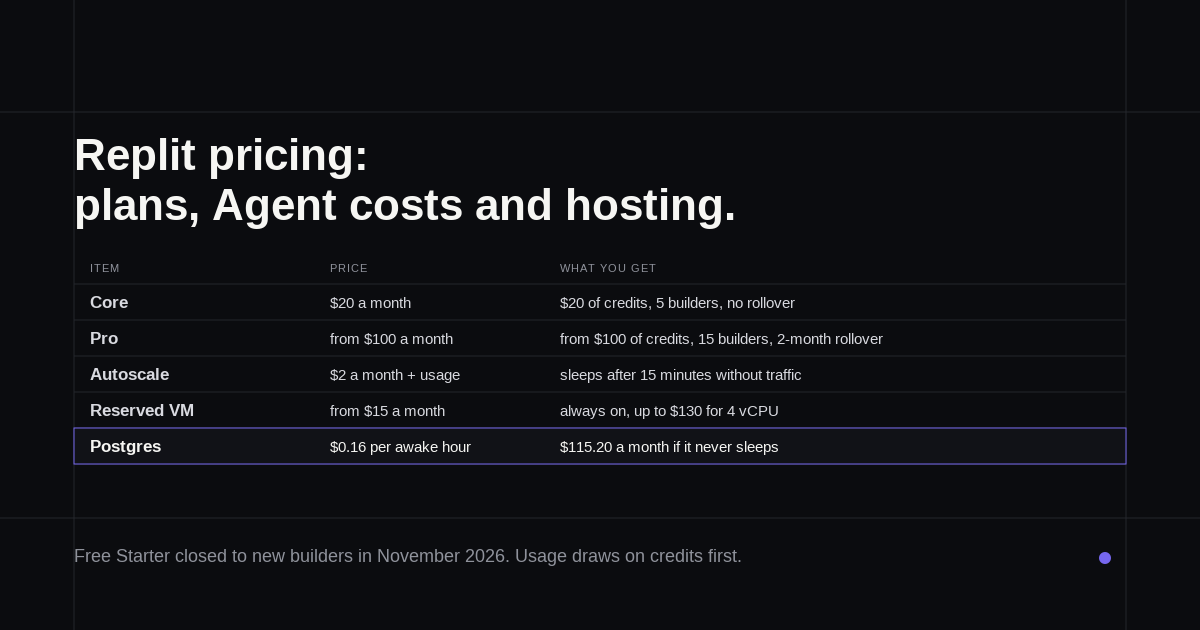
Replit pricing has two layers, and most people only look at the first. The subscription is easy to read, with Core at $20 a month and Pro at $100. The second layer is usage. Agent work in the paid modes, every published app, the production database and stored files are all metered, and the meters draw down the credits that come with your plan before anything else gets charged. This guide covers both layers as they stood on 28 November 2026, from Replit's pricing page and billing docs.
If you're already paying for an app on Replit and wondering where else it could live, the last section looks at Refinar, which keeps an app's code in your own GitHub account.
Replit pricing at a glance
| Plan | Monthly | Billed yearly | Credits included | Builders | Database restore |
|---|---|---|---|---|---|
| Starter | closed to new sign-ups | small monthly cloud credits | 0 | ||
| Core | $20 | $18 a month | $20 a month, no rollover | up to 5 | 7 days |
| Pro | from $100 | from $90 a month | from $100, rolls over for two months | up to 15 | 28 days |
| Enterprise | custom | custom | by contract | by contract | by contract |
Pro comes in credit tiers. The pricing page lists options from $90 up to $2,000 a month on the yearly plan, and the bigger tiers buy credits at a discount (Replit Pro docs). Core allows one background task at a time and Pro allows ten. Prices exclude tax.
Replit's FAQ puts yearly Core at $204, or $17 a month, while the pricing page says $18, so check the checkout total.
Is Replit free?
Not for new accounts any more. Replit's docs say that as of November 2026 the Starter plan "is no longer available to new builders" (Starter plan). What newcomers get instead is a 3-day free trial of Core, and starting it requires a payment method.
People who already had Starter keep it, with a limited Free Mode allowance, Lite build only, and one published app that carries a "Made with Replit" badge and goes down after 30 days unless you publish it again. Its production database is capped at 1 GiB. Older guides calling Replit free describe a plan you can no longer join.
How Replit Agent usage is billed
On Core and Pro, every request runs in one of three modes, and your choice of mode decides the cost.
Free Mode costs nothing within an allowance that refreshes every five hours, with a weekly limit on top. Core's pricing card describes it as up to 30 hours of chat across up to 60 projects. Replit picks the model for you, so you can't choose one.
Power and Max are the paid modes. Power is the cheaper default and Max uses stronger models for harder jobs. Both use what Replit calls effort-based pricing: each completed request produces one checkpoint, and its price depends on how much work it took. A typo fix costs little, while a feature that touches ten files is billed as a single, larger checkpoint (AI billing). Replit asks you to confirm before paid work starts, and you can hover over any checkpoint to see what it cost.
Two details catch people out. Planning counts as a normal request, so asking Max to plan a feature is billed even if no code changes. And when your app itself calls Claude, ChatGPT or Gemini through Replit's built-in AI integrations, those calls are charged at the provider's API rate and come out of the same credits.
Replit doesn't publish a fixed price per checkpoint, and the demo calculator its docs link to wasn't online when this was checked. Your own Usage page is the only reliable figure.
What deployments cost on top
Publishing is billed separately from building. All of it comes out of your monthly credits first (publishing costs).
| Deployment | Price |
|---|---|
| Autoscale | $2 a month base fee, $0.60 per million compute units, $0.40 per million requests |
| Reserved VM, shared 0.5 vCPU / 2 GB | $15 a month |
| Reserved VM, dedicated 1 vCPU / 4 GB | $35 a month |
| Reserved VM, dedicated 2 vCPU / 8 GB | $50 a month |
| Reserved VM, dedicated 4 vCPU / 16 GB | $130 a month |
| Static | free hosting, $0.05 per GB transferred |
| Scheduled | $2 a month base fee plus compute |
Autoscale sleeps after 15 minutes without traffic and only bills for the seconds it works, so a quiet app costs very little. Replit's own example, a small business site with 75,000 requests a month, comes to about $2.39. A Reserved VM stays on all the time, which suits apps that keep connections open or run background work. Core includes 100 GiB of outbound transfer a month, and above that it's $0.05 per GiB.
Database and storage
This is the line that grows quietly. The development database is free. The production database costs $0.16 for every hour it's awake and $0.35 per GiB stored each month (database billing).
"Awake" means receiving queries, plus five minutes after the last one. An internal tool used during office hours sleeps most of the night. An app with users in several time zones, or one with an uptime monitor pinging it every few minutes, may never sleep, and 720 hours at $0.16 is $115.20 a month before you've stored a single row.
Files uploaded to App Storage are cheap by comparison, at $0.015 per GiB a month plus small charges for transfer and operations.
What a running app costs per month
Take a booking app for a small clinic, published on Core with monthly billing. Staff use it on weekdays, the database is awake about ten hours a day, and the owner makes a handful of changes in Power mode. The Agent figure below is an assumption, because checkpoint prices vary.
| Item | Usage | Cost |
|---|---|---|
| Agent work in Power mode | 8 confirmed requests | about $12.00 |
| Autoscale hosting | 75,000 requests | $2.39 |
| Production database compute | 220 hours | $35.20 |
| Production database storage | 2 GiB | $0.70 |
| App Storage | 5 GiB of uploads | $0.08 |
| Usage total | $50.37 | |
| Covered by Core's $20 credits | −$20.00 | |
| Billed as extra usage | $30.37 | |
| Monthly bill with the $20 subscription | $50.37 |
The database is the biggest line, not the AI. The arithmetic also shows when Pro makes sense on cost alone. Because each plan's price comes back as credits, Core is cheaper for anyone whose usage stays under about $100 a month. Pro pays off through its seats, its larger Free Mode allowance and its rollover, or once usage regularly passes $100.
Keeping the Replit bill under control
Set a usage limit in Settings before you publish anything. The separate service shutdown limit suspends paid services once it's reached, which also takes the app offline, so pick that number carefully (managing spend). Keep everyday changes in Free Mode. Top-up credits expire six months after purchase.
Watch the hours on the Database tool's landing view. If they're close to the hours in the month, something is keeping it awake.
When the bill is the reason to look elsewhere
Many people checking Replit pricing already have an app running there and want to know how much of it could move somewhere that bills more predictably. The code moves easily, because Replit pushes to GitHub. Users signed in with Replit Auth, the data in Replit's database and the files in App Storage take more work, and Replit alternatives covers what each one needs.
Refinar is one option in that list. It changes apps connected from GitHub when you describe the change in plain language, with a live preview, and it builds new apps as ordinary code with a standard Postgres database that moves to your own GitHub account at go-live. Plans include 20 teammates and one live site on your own domain, and unused credits roll over while the plan is active. Prices vary by country and are listed on the pricing page. Changes that touch sign-in, payments or customer data are flagged, and if the team has a reviewer they wait for that person's approval before going live. It hasn't been proven yet on apps that use Replit Auth or Replit's hosted database, so for those, plan to replace sign-in and import the data first. If you came from another builder, Lovable pricing and the Base44 review run the same numbers.
To see how Refinar handles your app's repository, create a Refinar account.