platform transition · 5 min read
Best Vibe Coding Tools in 2026, Sorted by the Job You're Doing
Eight vibe coding tools sorted by what you're actually trying to do, with prices checked on the vendors' pages this week and the complaint users make most about each.
Updated 2026-09-12
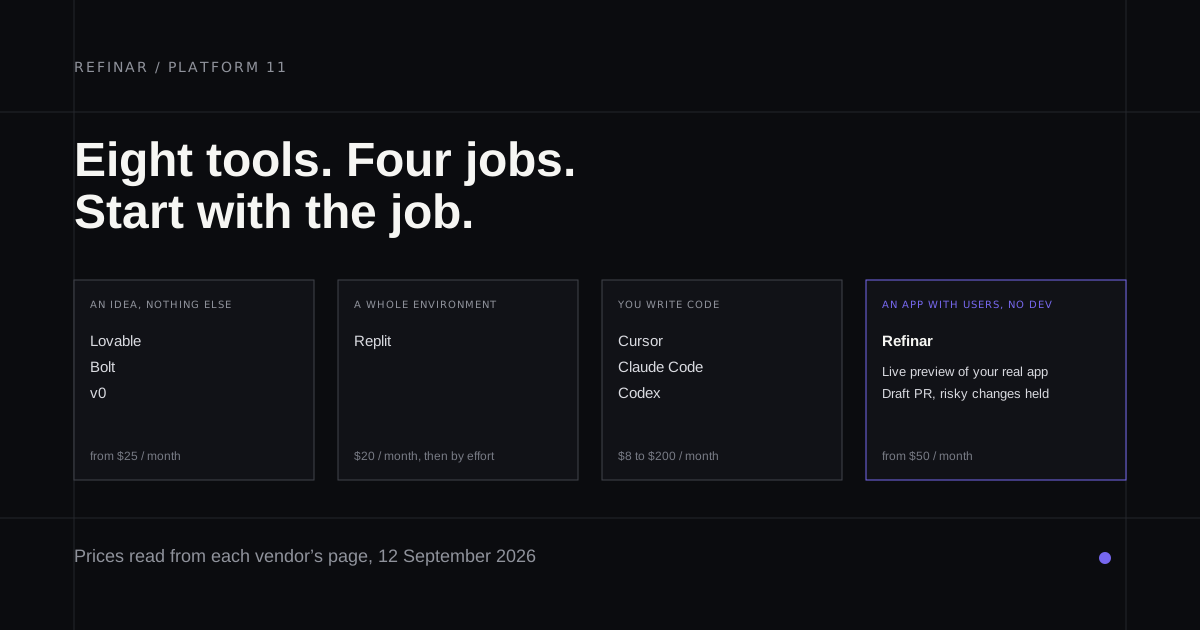
Most lists of vibe coding tools rank them one to ten, as if a founder with a napkin sketch and an engineer with a monorepo were shopping for the same thing. They aren't. The right tool depends on what you're walking in with, so this list is sorted by that instead.
Prices were read off each vendor's own pricing page on 12 September 2026, monthly billing, and every tool gets the complaint its users make most often. That second part matters more than the feature list. In 2026 almost every one of these bills by usage, and the sticker price is rarely what you pay.
If you have an idea and nothing else
Lovable. Best for: a polished web app from a blank page. Free plan with a few build credits a day, then Pro from $25 a month for 100 credits. The output looks finished faster than anything else here, which is why non-technical founders start with it. The complaint is credits. Since Agent Mode became the default, one request can trigger many billable steps, and Lovable's own credit docs confirm the model. Threads on r/lovable in August were full of people hitting a monthly limit mid-project.
Bolt. Best for: a live URL in an afternoon. Free, then Pro at $25 a month for ten million tokens. It runs in your browser tab, so there's nothing to install and it deploys from the same screen. Users on r/boltnewbuilders describe the failure mode as a loop. Ask it to fix a bug, it introduces another, fixes that, and half a million tokens later the first bug is still there. Larger React projects are where the preview gets unstable.
v0. Best for: a Next.js front end, especially if you already deploy on Vercel. Free with a small credit allowance, Plus at $30 per user per month. The pull-request workflow is the best behaved of the three, and it can import a repository you already have. The recurring gripe is opaque credit consumption, and one r/v0 thread traces a user's view from "pure magic" to something much less kind over a few months.
If you want a whole environment, not just a front end
Replit. Best for: full-stack apps in any language, with a database and a shell. Core is $20 a month, Pro $100. It's the only builder on this list where Python and Go are first-class, and it imports existing repositories. The complaint is the bill. Agent work is charged by effort on top of the subscription, there is no spending cap on by default, and a user on r/replit documented about $1,982 in agent charges over 24 days on an app with one user. Set a cap before you start.
If you write code and want to move faster
Cursor. Best for: everyday editing with an agent in the same window. Hobby free, Pro $20, Pro+ $60, Ultra $200. Still the editor most developers reach for. The forum tells the other half. Since plans moved to a dollar pool of model usage, picking a frontier model for every task drains the $20 plan well before month end, and the pricing model has changed more than once this year.
Claude Code. Best for: handing over a bounded, hard task in the terminal. Included with Claude Pro at $20 a month, Max from $100. It's the tool developers name for the refactors nothing else finishes. Two things to know. It shares a usage pool with ordinary Claude chat on Pro, so a heavy afternoon of conversations eats your coding allowance. And weekly limits change. The permanent setting from 14 September is about a sixth below what users had over the summer.
Codex. Best for: delegating tasks to the cloud if you already pay for ChatGPT. Free with limited access, Go $8, Plus $20, Pro from $100. Tasks run in an isolated container and come back as a diff or a pull request, which makes it the cheapest background agent for a ChatGPT subscriber. The complaint developers repeat is memory. It forgets context between sessions, and the container's internet is off during the loop unless you turn it on.
If the app already exists and you don't write code
Refinar. Best for: a product owner changing an app that's already live, with a developer approving the risky parts. From $50 a month for about 100 requests. It connects to the GitHub repository you already have, runs the app in a private sandbox with a live preview, and returns a draft pull request. Anything touching sign-in, payments or customer data waits for a developer to approve, yours or one of ours. Two limits. The app has to boot in a sandbox, and services are reached over HTTPS, so a client that opens a raw Postgres socket won't connect from a preview. We make it, so weigh this entry the way you'd weigh a vendor's.
Which one
- Napkin sketch, no code: Lovable for polish, Bolt for speed.
- Next.js and Vercel: v0.
- Any language, a real backend, and a spending cap you set on day one: Replit.
- You write code: Cursor to edit, Claude Code to delegate, Codex if ChatGPT is already paid for.
- An app with users and no developer on hand: Refinar.
If your app already exists, the import matrix shows what each builder does to your repository, and is vibe coding safe is the question to answer before any of these touches production.