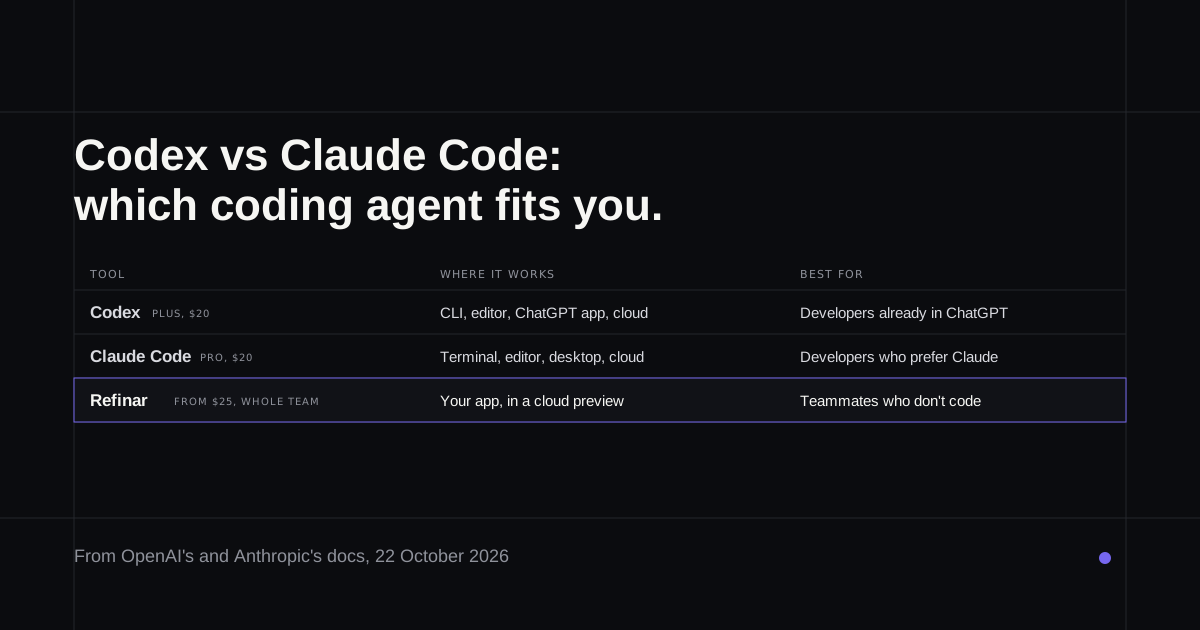
Two coding agents, both $20 a month to start, and a dozen articles that disagree about which one wins. A year ago Codex vs Claude Code was an easy split, with OpenAI's agent sending tasks to the cloud and Anthropic's sitting in your terminal. Each now runs in a terminal, an editor, a desktop app and the cloud, and each opens pull requests. What still separates them is how each keeps a risky command in check, how far a plan stretches, and whose models you'd rather use. October changed several of those answers, after most of the pages ranking for this were written.
If you don't write code and simply need your company's app changed, the last section is the one that applies to you.
Codex vs Claude Code at a glance
| Codex | Claude Code | |
|---|---|---|
| Cheapest way in | ChatGPT Free or Go ($8), desktop app only, as it rolls out | Claude Pro: $20 monthly, $17 a month yearly |
| Every surface from | ChatGPT Plus, $20 a month | Claude Pro |
| Heavy-use plans | Pro at $100, $200 or $500 | Max at $100 (5x Pro) or $200 (20x) |
| Models | GPT-6.1 Sol by recommendation, GPT-6 Astra, GPT-6 Luna | Opus 5.5 by default, Sonnet 5.5, Haiku 5.5, Fable 5.1 on request |
| Where it runs | CLI, IDE extension, ChatGPT desktop app, web, iOS | Terminal, VS Code, JetBrains, desktop app, browser |
| Default safety | OS sandbox on, network off | Auto mode, a second model checking each action |
| Instruction file | AGENTS.md | CLAUDE.md, or AGENTS.md when there's no CLAUDE.md |
| Source code | CLI is open source (Apache-2.0) | Closed |
From OpenAI's and Anthropic's docs and pricing pages on 22 October 2026.
What you pay, and how far it goes
Codex has no price of its own. It comes with ChatGPT, and Plus at $20 a month is where it turns into a working tool, adding the CLI, the editor extension, the web, iOS, cloud tasks, GitHub code review and Slack. Free and Go only get GPT-6 Luna in the desktop app, "subject to rollout" in OpenAI's words, which is enough to try it and not much more. Pro comes at $100, $200 or $500, with no five-hour limit on any of them (every tier, explained).
Claude Code isn't on Claude's free plan at all, so Pro at $20 is the floor. Max costs $100 for five times Pro's usage or $200 for twenty, with $100 to $200 a month of API credits thrown in (Claude pricing). Team plans almost mirror each other, with ChatGPT Business and Claude Team both at $20 a seat billed yearly or $25 monthly, plus $100 seats with five times the usage.
How far a plan goes is harder to compare. Both reset on a rolling five-hour window with weekly caps on top, and both share that allowance with the vendor's other agent work, ChatGPT Work for Codex and every Claude chat for Claude Code. OpenAI publishes rough figures for Plus, from 15 to 160 local messages per five hours on GPT-6.1 Sol up to 350 to 3,000 on Luna. Anthropic publishes multipliers only, and on Pro its top model, Fable, is paid from usage credits. Model choice moves the numbers more than the plan does, and October is an odd month to judge Codex by: on 4 October its lead promised an improvement or a full usage reset every day for 28 days.
Where each one does the work
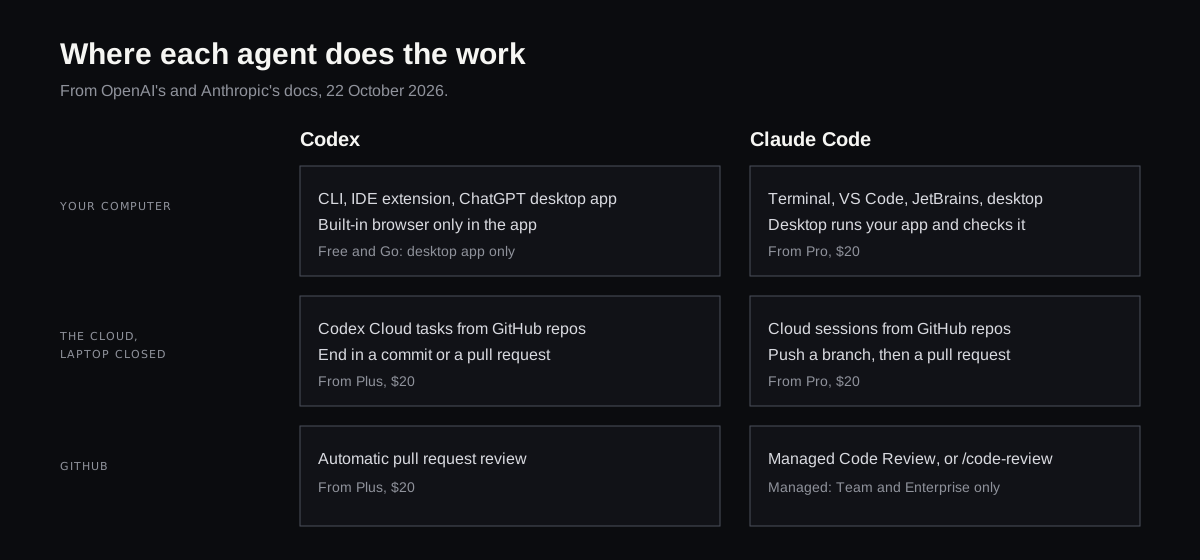
On your own machine the two are close. Codex runs as a CLI, an editor extension and a Codex mode in the ChatGPT desktop app, which absorbed the separate Codex app on 9 July; its built-in browser for checking a page lives only in that app. Claude Code's desktop app builds the checking into the loop, starting your dev server in a Browser pane and testing its own edits there.
Both hand work to the cloud too. A Codex Cloud task starts from an environment built from your GitHub repositories and "can keep working while your computer is asleep", ending in changes you commit or open as a pull request. Claude Code's cloud sessions clone from GitHub onto Anthropic's machines and push a branch, and --teleport pulls one back to your laptop (how that loop works).
Pull request review is where the plans differ. Codex reviews GitHub pull requests automatically from Plus up. Anthropic's managed Code Review left preview on 15 October, but only for Team and Enterprise, billed on usage credits on top of the plan. Any Claude plan can still run /code-review locally.
How each one stops a risky command
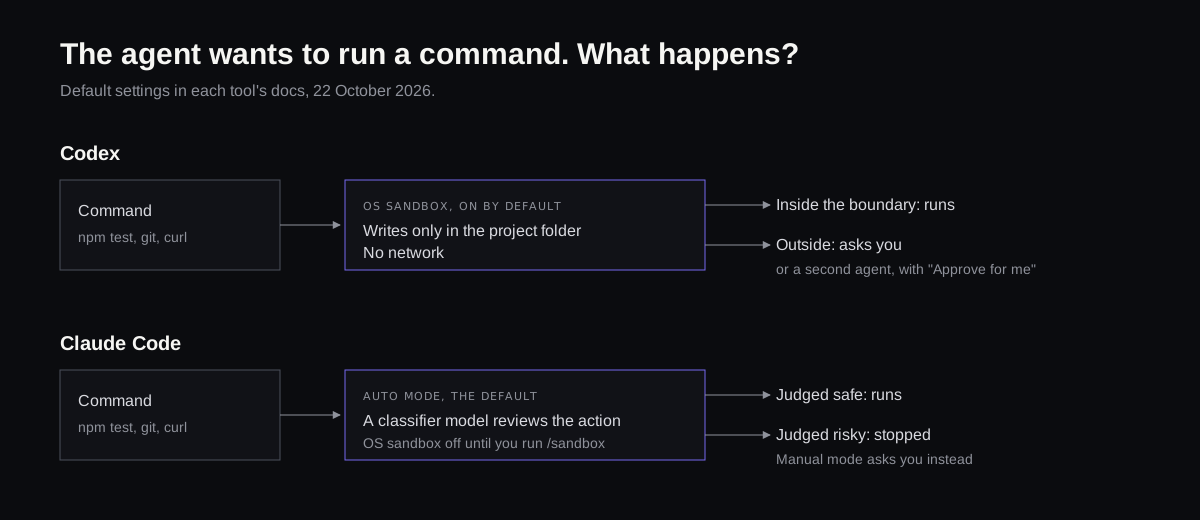
Most comparisons boil this down to "Codex has a sandbox, Claude Code doesn't", which misses how each default actually behaves.
Codex starts with a wall. Commands run inside an operating-system sandbox (Seatbelt on macOS, bubblewrap on Linux, a native one on Windows) that can write only to your project folder and has no network. Anything beyond that boundary stops and asks you. Pick "Approve for me" and those requests go to a second agent instead, which OpenAI made free for ChatGPT sign-ins this month.
Claude Code starts with a referee. From version 2.1.283 its default for terminal and VS Code work is auto mode, where a classifier model reviews each action and lets the safe ones run (permission modes). It has an OS sandbox for shell commands on macOS, Linux and WSL2, but that stays off until you run /sandbox.
If the project on your laptop holds real API keys in a .env file, Codex's default is the tighter one. Claude Code gets close once the sandbox is on, and its Manual mode asks before most edits and commands.
AGENTS.md, CLAUDE.md, and switching later
Older comparisons treat the instruction file as lock-in. Codex reads AGENTS.md from the repository root down to your folder and ignores CLAUDE.md unless you add it to a fallback list. Claude Code has read AGENTS.md since version 2.1.277, but only when there's no CLAUDE.md in the folder or above it. With both files present, it reads CLAUDE.md alone. AGENTS.md vs CLAUDE.md has a setup that keeps one file working for both.
The bigger change is on OpenAI's side. Codex can now import a Claude Code setup with /import in the CLI or from Settings in the desktop app. Instruction files become AGENTS.md, skills, MCP servers, hooks and subagents come across, and the CLI brings up to 50 chats from the last 30 days, leaving your Claude Code setup untouched. Trying the other tool costs an afternoon, not a migration.
Which should you pick?
- You already pay for ChatGPT Plus: Codex. It costs nothing extra.
- The agent will run on a laptop that holds production keys: Codex with its defaults, or Claude Code with
/sandboxswitched on. - You prefer Anthropic's models, or your repository already has a good CLAUDE.md: Claude Code.
- You want pull requests reviewed automatically on a small plan: Codex, since Claude's managed review needs Team or Enterprise.
- You'll use it all day: compare Codex Pro at $100, with no five-hour limit, against Claude Max at $100.
- You can't decide: both cost $20 to start, so spend a month on each.
- You don't write code: read on.
Weighing these against an app builder instead? Lovable vs Claude Code vs Codex covers that, and Antigravity vs Claude Code vs Cursor adds Google's and Cursor's agents.
If you don't write code
Both agents expect someone at the keyboard who can run the project and tell a safe command from a risky one before approving it. A product manager or operations lead who wants one screen of the company's app changed usually can't, and shouldn't have to learn.
Refinar comes at it from the other side. It connects to the repository your company already keeps on GitHub and runs the app in a cloud preview, so nobody installs anything. The person who wants the change describes it, or clicks the part of the page they mean, and watches it change in the preview. Anything that touches sign-in, payments or stored customer data waits for a developer's approval before it ships (how it works). One plan from $25 a month covers about 50 requests and 20 teammates (pricing), and if there's no app yet, Refinar's builder can start one from a description.
If a change to your team's app has been waiting on a developer for weeks, try Refinar on it.